

You think you know when you’re burned out, huh? Maybe what’s happening is that you’ve been living inside the feeling so long that it started sounding like identity instead of experience.
We repeat words like overwhelmed, exhausted, stressed, and burned out until the nervous system starts accepting them as permanent conditions instead of temporary states. To be fair, life has been a lot.
Years of uncertainty, adaptation, bad news, pressure, division, financial stress, and trying to hold ourselves together while still answering emails like everything’s perfectly normal. No wonder so many people feel like they can never quite land, fully exhale, or feel done.
Do you use the word burnout a lot? Maybe that’s ‘cuz you’re tired in ways that sleep doesn’t fix.
There’s this ongoing churn to modern life. We adapt to one “new normal” only to have it change again before we’ve fully caught our breath. The nervous system never really gets the memo it’s okay to stop bracing.
No wonder people fantasize about moving to a desert island with endless time, bounty, and no notifications.
Burnout isn’t always coming from one identifiable source. Sometimes it’s not the job, the relationship, the caregiving, or the responsibilities alone. Sometimes it’s the ongoing feeling that we can never quite land. Never fully exhale. Never feel done.
The way we talk to ourselves and others matters. The more we repeat words like burnout, overwhelmed, exhausted, and doomed, the more our nervous system starts treating them as identity instead of experience.
We stop saying “I feel overwhelmed right now” and start believing “I am a burned-out person.” That’s a very different thing to say.
In “Too Busy to Be Human,” I wrote about how many of us have become disconnected from our own humanity while trying to be productive enough, efficient enough, informed enough, responsive enough, optimized enough. Honestly, it’s a terrible job description for a human nervous system.
The interesting thing is this:
There have been many times in our lives when we worked incredibly hard and didn’t burn out at all.
We’ve spent entire weekends building a garden, helping a friend move, painting a room, learning something new, raising children, creating art, or building something meaningful with our own hands. The work was exhausting sometimes, yes, but also deeply fulfilling.
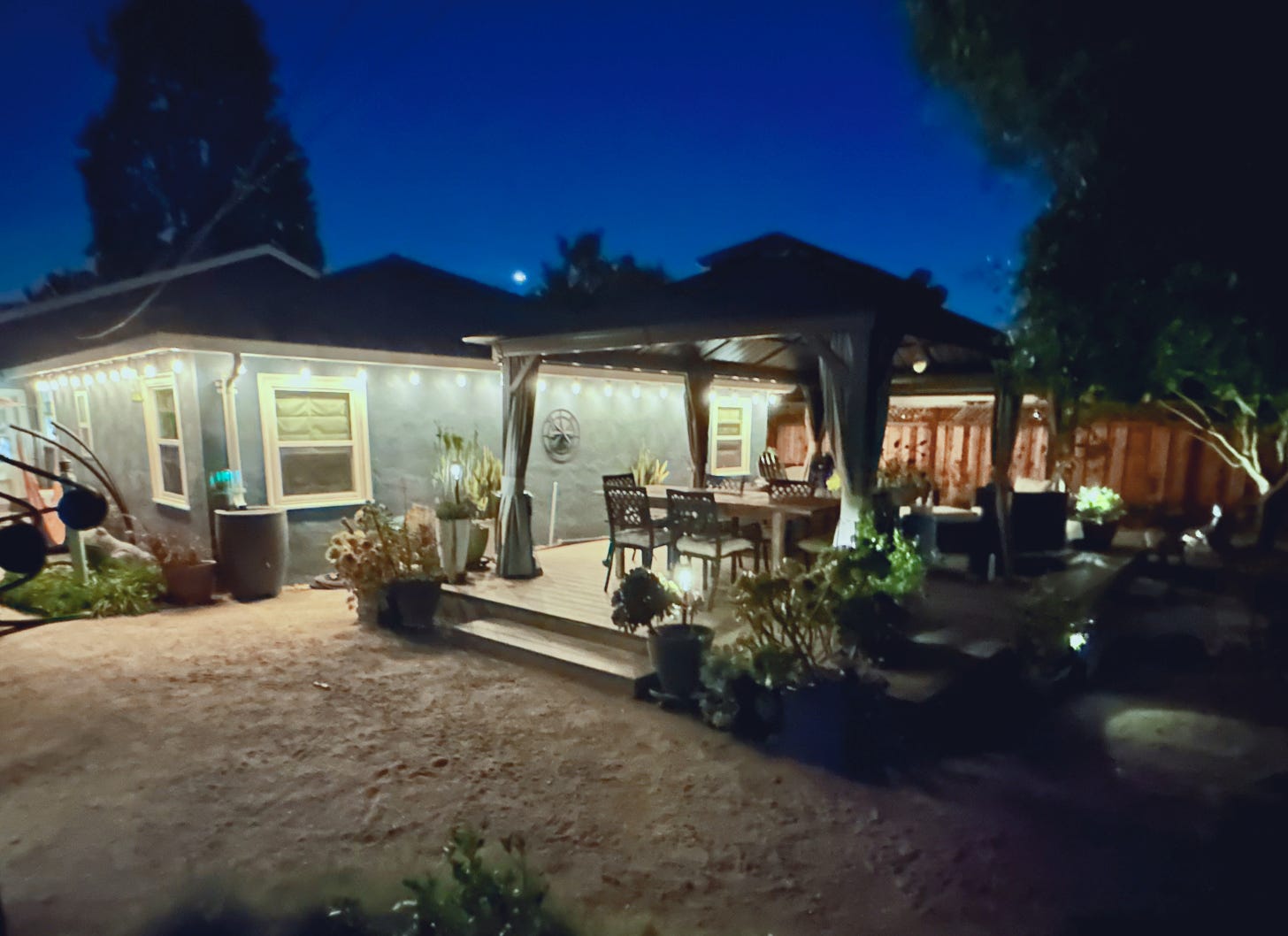
We spent countless hours creating a peaceful refuge for the family in our backyard. We agonized over landscaping, lighting, plants, structure, and tiny details nobody else would probably notice. We call it the sanctuary because that’s what it became. A place to breathe, reconnect, sip a cuppa tea, meditate, laugh with friends, and remember ourselves again.
The work mattered to us. Were there stressful moments? Hell yeah. But we pushed through it because we saw the vision we had growing before our eyes, and it was so rewarding.
Stress itself isn’t always bad. There are at least 2 kinds of stress to consider: eustress and distress.
Eustress is a signal that something meaningful is asking for our attention. This variety of stress activates us but instead of dread, there’s purpose, challenge, motivation, and even excitement. We prepare for things because the challenge feels possible and meaningful.
Distress occurs when the nervous system begins to believe there are too many demands and not enough resources. Not enough time. Not enough support. Not enough rest. Not enough safety. Not enough hope.
Sometimes the stress that finally knocks us on or asses isn’t even the “big thing.”
It’s one more email.
One more criticism.
One more bill.
One more newsflash.
One more night of no sleep with a newborn.
The straw that broke the camel’s back had very little to do with straw. We might be carrying grief, caregiving responsibilities, financial pressure, loneliness, fear about the future, or the exhaustion of trying to hold ourselves together while appearing fine.
Sometimes we simply don’t feel seen, and that can be brutal. We humans, like many other beings, are not built to thrive without a sense of belonging.
That sense of othering we see everywhere right now, whether it’s political, social, generational, cultural, or personal, wears on us more than we realize.
The nervous system relaxes in connection. It struggles in isolation. Mindfulness helps in very practical ways.
Not by pretending everything is fine.
Not by forcing positivity.
Not by bypassing very real pain or stress.
A moment of presence helps us pause long enough to notice what is actually here right now instead of what the mind keeps forecasting, replaying, catastrophizing, or labeling.
Right now:
Are you safe?
Have you eaten?
Have you rested at all?
Have you laughed recently?
What support do you have?
What pressure are you carrying that may not even belong to you anymore?
Mindfulness helps us downregulate reactivity by giving us a break from constant storytelling. It helps us come back to this moment instead of living inside twenty imagined futures.
We don’t need to solve our whole life. We need to stop doom-scrolling, unclench our jaw, drink water, text a friend, sit outside for ten minutes and breathe the fresh air, watch the hummingbirds, and remember that the nervous system responds to small moments of safety too.
Every one of these moments matter more than we think.
We don’t have to become perfectly resilient super-humans. Let’s make being human enough.